
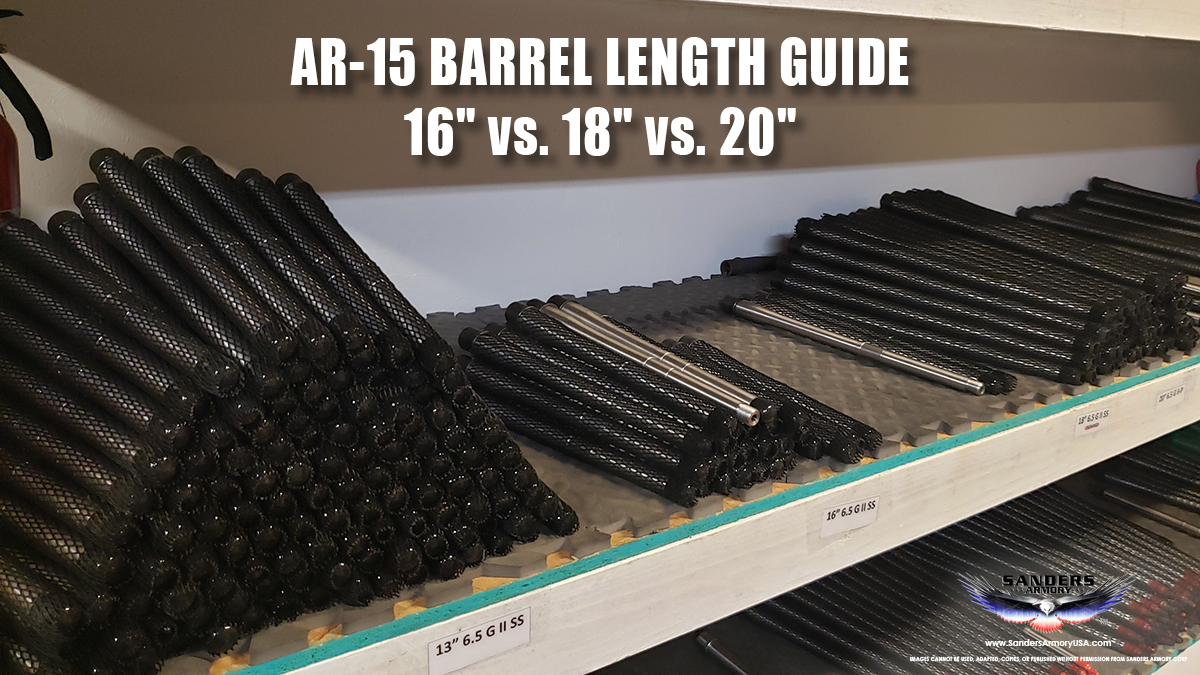
AR-15 Barrel Length Guide: 16 vs. 18 vs. 20 Inches
What’s the best barrel length for an AR-15?
The answer depends on what you’re asking the rifle to do. A 16-inch barrel may be right for one rifle, while an 18- or 20-inch barrel makes more sense for another. Caliber, ammunition, intended use and realistic shooting distance all matter.
Quick Answer
For many AR-15 rifle configurations:
- 16 inches offers a practical balance of performance and maneuverability.
- 18 inches can offer additional velocity and downrange performance while keeping the rifle manageable.
- 20 inches may make sense when additional velocity and downrange performance are a priority.
But barrel length alone doesn’t determine accuracy, reliability or how well a rifle will perform for your particular application. Let’s break it down.
At Sanders Armory, we start with a different question.
Start Here: What Are You Asking the Rifle to Do?
Before choosing a barrel length, define the rifle’s job.
- Are you building a general-purpose AR?
- Will you carry it through the woods while hunting?
- Are you hunting from a blind where a longer rifle isn’t much of a concern?
- Do you expect 100-yard shots or 300-yard shots?
- Are you trying to get more downrange performance from a cartridge such as 6mm ARC or 6.5 Grendel?
Those answers tell us much more than simply asking: “Should I buy a 16-, 18- or 20-inch barrel?”
Kelly Sanders, founder of Sanders Armory Corp, stands by this approach: “Begin with the end in mind, then build the rifle around it.”
How Does AR-15 Barrel Length Affect Performance?
Barrel length can affect several things, but these are the ones that matter most.
Velocity
In general, additional barrel length gives expanding gases more time to accelerate the bullet before it leaves the muzzle. How much velocity you gain depends on the cartridge, ammunition, projectile weight, powder characteristics and the individual barrel.
That’s why an extra two inches doesn’t produce the same result with every AR-15 caliber.
The question isn’t just: “How much faster is it?”
It’s: “Does the difference matter for what I’m doing with the rifle?”
Handling, Weight and Balance
A shorter rifle is generally easier to maneuver through woods, around a blind or anywhere space is limited. But length alone isn’t the only factor to consider. Barrel profile, handguard, optic, stock and accessories all affect the finished rifle’s weight and balance.
A heavy-profile 16-inch barrel can weigh more than a tapered-profile 18-inch barrel. Where that weight is located also matters. More weight toward the front of the rifle can make an 18- or 20-inch build feel considerably heavier when carried or shouldered.
A tapered or medium-profile barrel removes some of that forward weight and can provide better overall balance.
If the build is for a younger person or someone with less upper-body strength, weight and balance are especially important considerations for reducing fatigue and maintaining safe, comfortable handling.
Gas-System Operation
Barrel length and gas-system length are related, but they aren’t the same thing.
Gas-port location, gas-system length and port size can vary between barrels regardless of overall barrel length. Ammunition, pressure, dwell time, buffer components, barrel length and the choice between a standard or adjustable gas block can all affect how an AR cycles.
This is a major reason we look at the entire build, rather than choosing individual components in isolation.
KNOWLEDGE DROP: Simply put, an AR-15 is a system. Changing one component can affect how other components work with it. If you’re unsure about changing a component on your build, call us before you buy. We’d rather help you work through it first.
16 vs. 18 vs. 20 Inch AR-15 Barrels
Here’s the simple version.
| Barrel Length | Think of It As | Often Considered For |
|---|---|---|
| 16″ | Versatility | General purpose, carrying, woods and hunting |
| 18″ | Balance | Hunting, distance and performance without moving to 20″ |
| 20″ | Performance | Applications where additional velocity and downrange performance matter most |
These are starting points—not rules.
16-Inch AR-15 Barrels
For many AR-15 applications, 16 inches is a good place to start. It keeps the overall rifle manageable while providing useful performance from many popular AR-15 cartridges.
A 16-inch barrel may make sense if:
- You want a general-purpose rifle.
- You’ll carry the rifle while hunting.
- You hunt in woods or tighter terrain.
- Maneuverability matters.
- You don’t need to squeeze every bit of available velocity from the cartridge.
The caliber still matters. A 16-inch barrel doesn’t affect every cartridge the same way.
18-Inch AR-15 Barrels
Think of 18 inches as the middle ground. You’re adding some barrel length while potentially gaining useful velocity from cartridges that benefit from it.
An 18-inch barrel may make sense when hunting or longer-distance performance is important, but you still want a reasonably manageable rifle. This can make 18-inch configurations particularly interesting with cartridges such as .223 Wylde/5.56, 6mm ARC and 6.5 Grendel. Those cartridges don’t require an 18-inch barrel. The question is whether the additional performance makes sense for your final application.
20-Inch AR-15 Barrels
A 20-inch barrel shifts the priority more toward getting performance from the cartridge and less toward keeping the rifle compact.
This may make sense if longer-range performance is important, you’re shooting primarily from supported positions, or your cartridge benefits enough from the extra barrel length to justify it. One important distinction: A 20-inch barrel isn’t automatically more accurate than a 16-inch barrel simply because it’s longer. It may produce additional velocity with a particular load, which can affect trajectory and downrange performance. That’s different from saying the barrel itself is more accurate.
How Does Caliber Affect AR-15 Barrel Length?
You can’t choose barrel length without considering the caliber. While this guide focuses primarily on 16-, 18- and 20-inch barrels, some AR-15 cartridges are commonly used in other barrel lengths. .300 Blackout is a good example, with a 10.5-inch configuration serving a different purpose than a 16-inch rifle.
This is why we’d rather hear:
“I’m building a 6mm ARC primarily for hunting, and I expect most of my shots to be between 100 and 300 yards.”
than:
“Should I buy an 18-inch barrel?”
Now you’ve begun with the end in mind, and we can start narrowing down the right configuration.
Does a Longer AR-15 Barrel Improve Accuracy?
Not automatically.
Barrel quality, chamber, ammunition, projectile stabilization, barrel harmonics, optics and the shooter can all affect accuracy. A quality 16-inch barrel can be just as accurate as a longer barrel.
Return to the original question: “What am I looking to accomplish with the build?”
Additional barrel length may provide more velocity and affect downrange performance. That doesn’t automatically make the longer barrel more accurate.
What About Twist Rate?
Barrel length is only one specification to consider.
Twist rate describes how quickly the rifling rotates the projectile as it travels through the barrel. For example, a 1:8 twist means the rifling completes one full rotation in eight inches.
The appropriate twist rate depends on the caliber and the projectiles the barrel is intended to stabilize.
So don’t choose a barrel based on length alone.
Consider:
Caliber • Barrel Length • Twist Rate • Barrel Profile • Gas System • Ammunition • Intended Use
The components need to make sense together.
Before You Choose an AR-15 Barrel
Answer these five questions:
- What caliber are you building?
- What is the rifle’s primary job?
- If you’re hunting, what game and terrain are involved?
- What distances will you realistically shoot?
- Is maneuverability or getting more performance from the cartridge more important?
Once you know those answers, choosing between 16, 18 and 20 inches becomes much easier.
There Is No One “Best” AR-15 Barrel Length
A good AR-15 isn’t built around whichever barrel length happens to be popular.
It’s built around what you need the rifle to do.
At Sanders Armory, that’s where we start:
Define the job. Choose the caliber. Then choose the barrel and components that make sense for that application.
Need Help Choosing an AR-15 Barrel or Upper?
Not sure which configuration makes sense for your build? Tell us the caliber you’re considering, how you plan to use the rifle and your realistic shooting distance.
We can help you work through barrel lengths, components and built-to-order upper options.
Frequently Asked Questions About AR-15 Barrel Length
What is the best all-around AR-15 barrel length?
For many applications, a 16-inch barrel offers a useful balance of performance and maneuverability. The best choice still depends on caliber, ammunition and intended use. Hunting and longer-range applications may make an 18- or 20-inch barrel worth considering.
Is an 18-inch AR-15 better than a 16-inch AR-15?
Not automatically. An 18-inch barrel may provide additional velocity with some cartridges, while a 16-inch rifle is generally more compact. Whether those extra two inches are useful depends on what you’re asking the rifle to do.
Is a 20-inch AR-15 more accurate than a 16-inch AR-15?
Not simply because it’s longer. Barrel quality, ammunition, projectile stabilization and other factors contribute to accuracy. A longer barrel may provide additional velocity, which can affect downrange performance.
Is a 16-inch AR-15 good for hunting?
It can be. Sanders Armory has many customers who specifically use a 16-inch barrel because of its maneuverability, lighter overall configuration and suitability for closer-range hunting applications.
The best choice still depends on your end-use goals, caliber, game, terrain and realistic shooting distance. A hunter carrying a rifle through the woods may value a 16-inch configuration differently than someone hunting from a supported position at longer distances.
Is an 18-inch barrel good for 6mm ARC?
An 18-inch 6mm ARC is a popular choice among hunters and can offer a useful balance between rifle size and cartridge performance. Whether a 16-, 18- or 20-inch barrel makes more sense still depends on how the rifle will actually be used.
Should I choose caliber or barrel length first?
Start with what you want the rifle to accomplish. Choose an appropriate caliber for that application, then select the barrel length and other components that allow that cartridge to meet your requirements.